
The Future of Banking: Where Digital Transformation Meets Human Connection
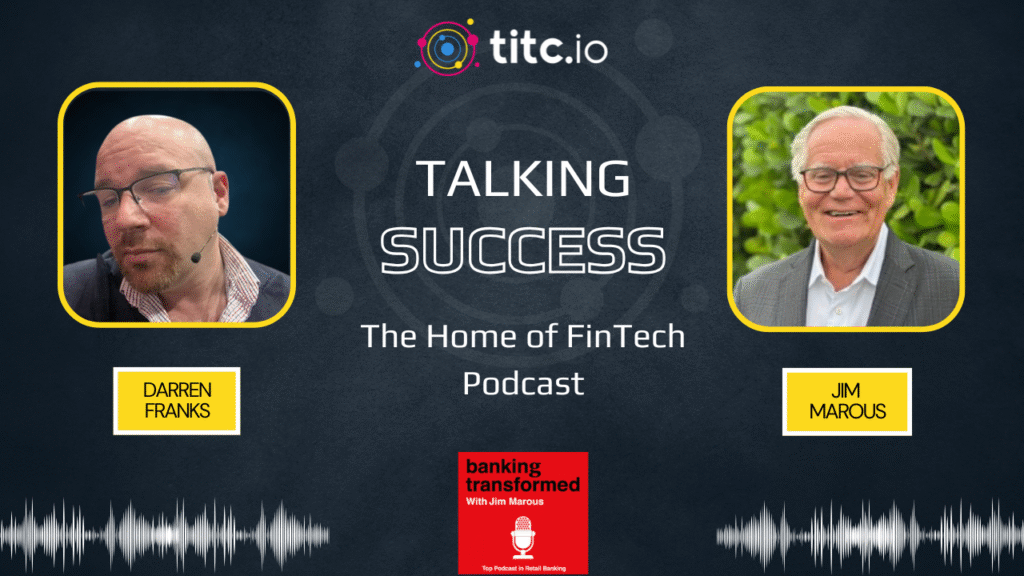
In this episode, “The Future of Banking: Where Digital Transformation Meets Human Connection”, of Talking Success, The Best Fintech Podcast, Darren Franks sat down with Jim Marous– global banking influencer, co-publisher of The Financial Brand, host of Banking Transformed, and one of the most respected voices in digital banking.
For decades, traditional banking has relied on physical presence – branches, tellers, and personal relationships. Yet as digital adoption accelerates and neobanks disrupt legacy systems, the conversation has shifted. What role will branches play in a future where onboarding takes less than ten minutes on a smartphone? And can banks deliver genuine human connection without a physical footprint?
These are the questions that defined Darren and Jim’s conversation, touching on everything from financial inclusion in Africa to customer trust, the impact of AI, and what it really means to build a “phygital” bank of the future.
The Evolving Role of the Branch
When Talking Success host Darren Franks mentioned seeing Jim Marous alongside Brett King, Chris Skinner, and David Birch – the so-called “four musketeers” of FinTech thought leadership – it set the tone for a deep discussion about what’s next for global banking.
Jim shared reflections from his recent travels, including a trip to Saudi Arabia, where the country’s rapid transformation has made it a new epicentre of innovation in financial services. But even amid this wave of modernisation, one thing remains clear: the branch still has symbolic importance.
“The role of the branch isn’t dead,” Marous explained. “It’s changing. It’s evolving into a place of consultation and community rather than transaction.”
He pointed out that in mature markets like the U.S., U.K., and Europe, physical branches are being re-imagined rather than eliminated. They’re becoming “advice hubs” – hybrid spaces where technology and human expertise coexist. Banks such as JP Morgan Chase and Barclays have experimented with smaller, digitally-driven outlets that use data and automation to anticipate customer needs before they walk through the door.
From Relationship Banking to Transactional Banking
Franks noted that in the past, banking relationships were personal. “Your parents banked with a certain institution, and that’s who you banked with. You knew the manager, the tellers – it was a relationship,” he said.
Today, banking has become largely transactional. With the rise of digital onboarding and e-KYC, customers can open an account with multiple banks in minutes. This has created a “multi-bank mindset,” where loyalty is replaced by convenience.
According to Jim Marous, this shift doesn’t necessarily mean that trust has eroded – it has simply evolved. Consumers now place trust in accessibility and problem resolution rather than in physical presence. “People don’t necessarily distrust banks,” Marous said. “They just want to know that if something goes wrong, there’s someone they can reach – and that their issue will be resolved quickly.”
That insight is particularly relevant in emerging markets like South Africa, where access and inclusion remain key. While neobanks such as TymeBank and Revolut push the boundaries of branchless banking, many consumers in lower-income segments still prefer some degree of physical or human connection.
Trust, Access, and the Human Element
The conversation turned to trust – a concept often misinterpreted by the FinTech industry. Darren Franks highlighted that, in many African townships and low-income communities, mistrust in banks isn’t about fear of losing money. It’s about the perception that when something goes wrong, customers are on their own.
“When a payment fails or someone needs flexibility, there’s often no one to talk to,” Franks said. “That’s where trust breaks down.”
Marous agreed, emphasising that this is where digital banks risk over-automating the customer experience. “You can’t have a relationship if your policy is ‘we don’t speak to customers,’” he noted – referencing an all-too-familiar experience where chatbots or automated responses replace genuine interaction.
For banks, this presents a paradox: how to maintain cost-effective, scalable digital models while ensuring that customers still feel heard. The solution, both agreed, lies in leveraging digital tools to enhance, not replace, human connection.
The Rise of “Phygital” Banking
One of the most interesting concepts discussed was the idea of “phygital banking” – blending physical and digital experiences into a cohesive ecosystem. The term, originally popularised by Marous and Brett King, reflects the idea that banks can deliver seamless service whether the customer is online, on a call, or in a branch.
Marous argued that branches of the future will operate more like experience centres or co-working spaces – equipped with digital screens, automated kiosks, and remote advisors available via video. “We’re not talking about teller lines anymore,” he said. “We’re talking about collaborative engagement – helping customers plan for their financial goals.”
Darren Franks added that while he personally can’t imagine standing in a long queue at a branch again, there’s still a case for virtual face-to-face banking. “Why can’t we have Teams or Google Meet calls with bankers?” he asked. “That’s still personal, but scalable – and it bridges the gap between digital convenience and human empathy.”
This model already exists in some form. Banks like NatWest and ABSA are experimenting with virtual consultations, allowing customers to speak directly with relationship managers through secure video calls.
Overbanked vs. Underbanked
A striking point of reflection was Marous’s observation that while much of Africa remains underbanked, some developed markets may now be overbanked.
In the U.S., for example, thousands of regional banks and credit unions compete for the same customers, while digital players like Chime, Varo, and SoFi continue to expand. This fragmentation creates inefficiency and rising customer acquisition costs, leading to consolidation — a trend also seen across Europe.
Conversely, in Africa, the opportunity lies in scale and accessibility. As Franks noted, “We’re seeing an explosion of neobanks entering Africa, but success will depend on how well they understand local behaviour — not just technology.”
From biometric onboarding to partnerships with mobile-money agents, African FinTechs are redefining inclusion. Initiatives by players like M-Pesa and FairMoney demonstrate how digital banking can reach millions of previously excluded users — a sharp contrast to markets struggling with oversupply rather than scarcity.
AI, Automation, and the Compliance Conundrum
Both Franks and Marous acknowledged that artificial intelligence and automation have transformed the banking process, yet banks remain deeply risk-averse. “They’re so focused on compliance and regulation that innovation often takes a back seat,” Franks observed.
He cited examples from South Africa, where documents still require multiple manual reviews despite the potential for automation. “There are entire floors of people doing what could be done in seconds,” he said.
Marous agreed but pointed out the reason: liability. Banks fear that AI-driven recommendations might cross the line into regulated “financial advice.” The challenge is designing explainable AI — systems that are both transparent and compliant.
Nevertheless, automation presents an enormous opportunity for operational efficiency and personalisation. Predictive analytics can alert banks when a customer’s cashflow is under pressure, or when small businesses are ready to expand — enabling proactive engagement rather than reactive service.
Banking as an Ecosystem Partner
One of the standout moments of the episode was Darren Franks’s idea that banks could evolve from service providers to growth partners.
“If my bank knows that I run a FinTech recruitment business,” he explained, “and it can see that several firms in my sector are expanding their payrolls, why not connect me with them? That helps me grow, helps them find talent, and ultimately drives more transactions. Everyone wins.”
This vision of “banking beyond banking” aligns with Marous’s advocacy for ecosystem-based financial models. Rather than selling products, banks can create value networks — offering insights, partnerships, and tools that support their customers’ broader goals.
Examples of this model are already emerging through Banking-as-a-Service (BaaS) platforms and open-banking APIs. Companies like Solarisbank, Railsbank, and Mambu enable institutions to embed financial services into non-financial ecosystems — from e-commerce to HR management.
Customer Experience as the New Differentiator
As competition intensifies, customer experience (CX) has become the true battleground for banks. Marous emphasized that the “expectation bar” keeps rising, driven by comparisons not with other banks but with tech giants like Apple, Amazon, and Netflix.
When customers can track a delivery in real time or get a personalised playlist, they expect similar convenience and relevance in their financial lives. That means hyper-personalisation, predictive insights, and intuitive design — all built on the foundation of trust and transparency.
Banks that fail to adapt risk being relegated to utility status, while those that invest in data-driven empathy — using insights to anticipate needs — will thrive.
The Road Ahead
As the conversation wrapped up, both Franks and Marous reflected on what the next two years might hold for banking.
The consensus: continued convergence. Physical and digital experiences will blur; banks will rely more heavily on data, AI, and partnerships; and success will depend less on scale and more on relevance.
For emerging markets like Africa, this transformation represents both a challenge and a leapfrog opportunity. With mobile adoption soaring and FinTech innovation flourishing, the region could redefine what “digital banking” means on a global scale.
As Marous put it, “The future of banking isn’t about technology alone — it’s about using technology to make people’s lives better.”
And that’s where the next decade of financial innovation will be won or lost.
FAQ's
Jim Marous is a globally recognised banking influencer, author, and keynote speaker. He is the Co-Publisher of The Financial Brand, Owner and Host of the *Banking Transformed Podcast, and CEO of the Digital Banking Report.
With decades of experience in financial services, Marous is known for his forward-thinking analysis of how digital transformation, data, and customer-centric innovation are reshaping the financial industry.
Jim doesn’t believe that branches are “dead” – he believes they’re evolving.
In his view, branches will transition from being transaction hubs to relationship and advisory centres, where digital and physical experiences merge.
“The branch of the future isn’t about teller lines – it’s about collaboration, consultation, and using data to make human interaction more valuable.”
He often refers to this model as “phygital banking” – the blend of physical and digital experiences.
For Jim, digital transformation isn’t just about technology – it’s about rethinking business models around the customer.
He argues that banks must move from product-centric to customer-centric approaches, using data, AI, and automation to deliver personalised, real-time experiences.
“Digital transformation isn’t a technology initiative. It’s a culture shift that starts with leadership and ends with better customer outcomes.”
He also highlights that transformation is continuous – not a one-time project – and that institutions must constantly adapt to rising expectations shaped by brands like Amazon and Apple.
Marous believes that trust is the new currency of banking, but it’s no longer built solely through face-to-face relationships.
Instead, trust today is earned through transparency, reliability, and accessibility.
“People don’t necessarily distrust banks – they just want to know that when there’s a problem, someone will be there to help.”
He cautions that over-automation can erode trust if customers feel unseen or unheard, urging banks to use technology to enhance human connection, not replace it.
The biggest challenge, according to Marous, is staying relevant in a fast-moving ecosystem where tech giants and fintechs are redefining financial experiences.
Legacy institutions struggle with culture, compliance, and legacy systems – yet they also hold a massive advantage: data and customer relationships.
“The winners in banking won’t be those with the most branches or biggest budgets, but those who can turn customer data into proactive, empathetic engagement.”
He sees opportunity in collaboration, open banking, and ecosystem-based models where banks act as growth partners rather than just service providers.